
Fatal Dimensions – text-based MUDs and classic online RPGs
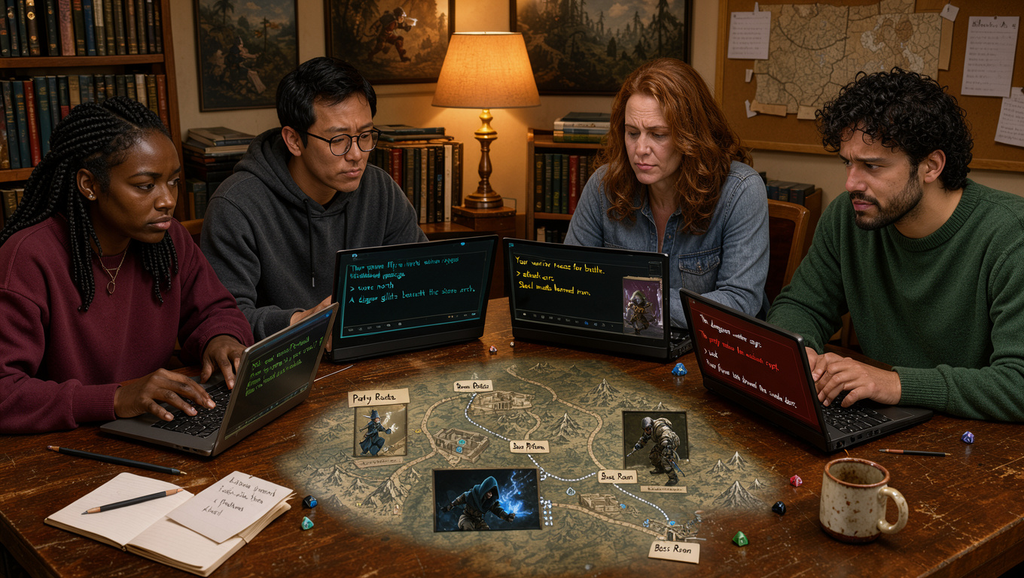
Welcome to Fatal Dimensions, our home for text-based multi-user dungeons and classic online role-playing adventures. This is where imagination still outshines graphics, and stories are written collaboratively, one keystroke at a time.
We built this space for players who remember typing commands into a glowing terminal and watching entire worlds unfold through words alone.
We also welcome newcomers who are curious about what MUD games actually involve and how they differ from modern graphical titles.
Throughout this article, we’ll explain the fundamentals of these text-driven realms, from character creation to combat and exploration.
We’ll then walk through practical steps for joining our community using Mudlet, a popular client that makes connecting simple.
Fatal Dimensions has grown from genuine passion rather than commercial ambition. This project reflects decades of dedication from a small but devoted team. We value imagination, storytelling and community over flashy visuals, and we’re excited to share that spirit with you.
What Are MUD Games?
At their heart, MUD games are shared stories, written collaboratively by hundreds of players typing commands into a single persistent world. MUD stands for Multi-User Dungeon, a name that hints at the genre’s roots in early computer networks and shared adventuring. Unlike modern video games, everything happens through text: descriptions of rooms, monsters, and other players appear on screen, and you respond by typing simple commands.
This might sound unusual to newcomers raised on high-definition graphics, but MUD games were actually among the very first multiplayer experiences ever created. They emerged in the late 1970s at the University of Essex, built by students who wanted to combine the social fun of tabletop role-playing with the connectivity of early computer networks. Dungeons & Dragons heavily influenced their design, lending MUDs their emphasis on character classes, quests, and collaborative storytelling.
We like to think of a MUD game as interactive fiction with friends. Each session blends several familiar elements into one experience:
- Role-playing, where you create and develop a unique character
- Exploration, as you navigate rooms, dungeons, and towns built entirely from text
- Combat and strategy, often governed by stats and skills similar to tabletop games
- Social interaction, since other real players share the world with you
Over the decades, these foundations evolved into what we now call the text-based RPG genre. Graphics-based MMORPGs eventually overshadowed MUDs commercially, yet the text-based RPG never disappeared. It simply found a loyal, dedicated following who valued imagination and community over flashy visuals.
We’re proud custodians of that tradition. Whether you’re entirely new to MUD games or you’ve spent decades typing commands into glowing terminal windows, we’ve built Fatal Dimensions to honour that rich, text-driven heritage.
Discovering Fatal Dimensions
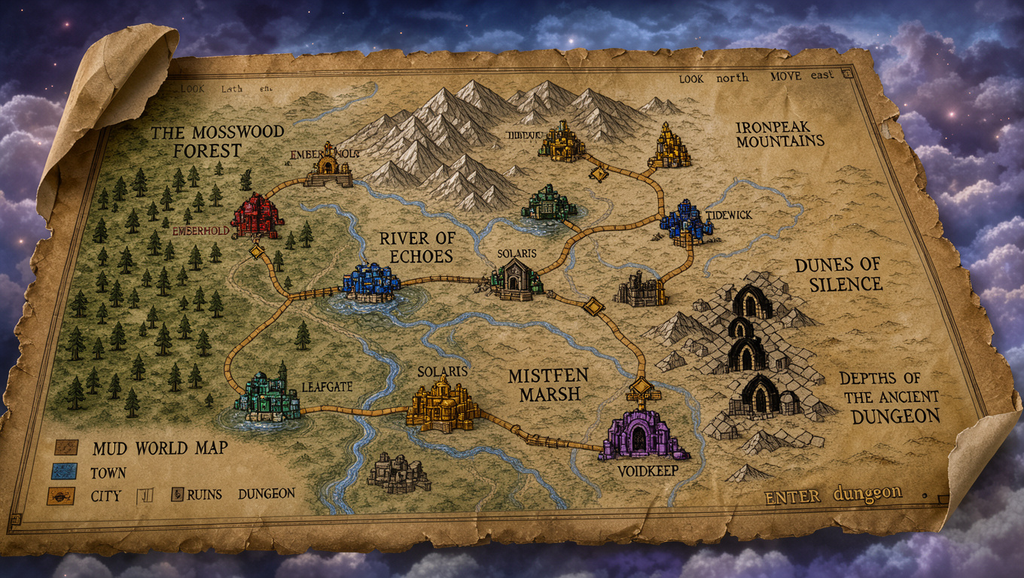
When we set out to create Fatal Dimensions, our goal was never to chase trends but to build something lasting within the world of MUD games. We wanted a place where stories could breathe, where players could shape their own paths, and where a single typed command might open a door to an entire realm.
Fatal Dimensions carries a dark, layered atmosphere. Shifting kingdoms, forgotten ruins, and morally grey factions give our world texture and tension. We built this setting with care, drawing on classic fantasy roots whilst leaving room for players to leave their own mark on the lore.
Our design philosophy centres on three things: imagination, community, and long-form storytelling. Unlike many modern MUD games that rush players towards endgame content, we encourage slow discovery. We believe the best adventures unfold gradually, built through conversation, exploration, and shared history with fellow players.
We take pride in our longevity. Fatal Dimensions has weathered changing gaming fashions and survived because our community kept returning, year after year. This isn’t a fleeting project thrown together for quick attention. It’s a living, breathing world shaped by thousands of hours of collective storytelling.
The table below highlights what sets our approach apart from many typical MUD games found elsewhere online.
| Design Element | Fatal Dimensions | Typical MUD Games |
|---|---|---|
| Storytelling Pace | Gradual, player-driven narrative | Fast-paced, goal-focused progression |
| World History | Deep lore built over many years | Often limited or static backstory |
| Community Involvement | Active role in shaping ongoing events | Minimal player input on world direction |
| Longevity | Established, continuously supported | Many projects fade after a few years |
This foundation is just the beginning. In the sections ahead, we’ll explore exactly what makes our corner of the MUD games world so distinctive, from our community-driven updates to the tools we offer every newcomer.
Why Text-Based RPGs Still Captivate Us
Despite the rise of cinematic, big-budget gaming, text-based RPGs continue to thrive, and we think we know why. These games ask something different of players than modern graphics ever could. They invite us to build worlds in our own minds rather than simply watching one unfold on screen.
At Fatal Dimensions, we’ve seen first-hand how this simple idea keeps players coming back year after year. There are two reasons that stand out above the rest.
Imagination Over Graphics
When you strip away the visuals, something interesting happens. Your brain takes over, filling in every detail the text doesn’t spell out.
A dragon described in a few lines becomes exactly as terrifying as you need it to be. A dungeon corridor stretches as far as your mind allows. This is the heart of any great text-based RPG experience.
No two players picture a scene the same way. That personal touch gives these games a depth that polished 3D graphics often struggle to match.
We’ve found that this creative freedom keeps players engaged far longer than flashy animations ever could. Once you’ve pictured your own version of a world, you tend to care about it a great deal more.
Building Genuine Online Communities
Text-based RPGs don’t just spark imagination; they build real friendships. Players work together to solve puzzles, plan strategies, and tell shared stories that can run for years.
Within our own community, we see veteran adventurers take new players under their wing. They explain the ropes, share tips, and welcome newcomers into guilds and quests.
This kind of mentorship rarely happens by accident. It grows naturally from typing messages back and forth, from solving problems side by side rather than racing through a solo campaign.
- Shared storytelling that develops over weeks or months
- Mentorship between experienced and new players
- Collaborative problem-solving during quests and battles
- A sense of belonging that outlasts any single gaming session
We believe this warmth and inclusivity is what truly sets a text-based RPG apart from most modern games. The friendships formed here often last long after the adventure ends.
Getting Started With Mudlet
There’s one piece of software that makes exploring Fatal Dimensions feel effortless, and it’s called Mudlet. We recommend this free, open-source client to every new adventurer who joins us, whether they’ve played MUDs for decades or never touched one before.
Mudlet works smoothly across different operating systems and packs in features that make text-based gaming genuinely enjoyable. Setting it up takes only a few minutes, and we’ll walk you through each stage below.
Downloading and Installing Mudlet
Head to the official Mudlet website and select the version that matches your system. Windows, macOS, and Linux users will all find a straightforward installer waiting for them.
Once downloaded, run the file and follow the on-screen prompts. The installation process rarely takes more than a couple of minutes, and Mudlet requires no technical expertise to get running.
After installation finishes, launch the programme and you’ll see a clean, welcoming interface ready for your first connection.
Connecting to Fatal Dimensions
With Mudlet open, click on the option to add a new profile. This is where we’ll enter the details that link you directly to our world.
Type in our server address along with the correct port number, both of which you’ll find listed on our website’s connection page. Save these settings under a profile name you’ll recognise, perhaps “Fatal Dimensions”.
Press connect, and within seconds you’ll see our opening screen appear. From there, creating your character is simple, and you’ll be stepping into the game world before you know it.
Customising Your Interface
One of Mudlet’s biggest strengths lies in how much you can tailor it to your own taste. Fonts, background colours, and window layouts can all be adjusted through the settings menu.
Many players also set up triggers, small scripts that automate repetitive actions or highlight important text. These aren’t essential for beginners, but they become useful as you grow more confident.
We encourage everyone to experiment until their screen feels comfortable and personal. After all, a setup that suits you makes every session in Fatal Dimensions more enjoyable from the very start.
Understanding ROM MUD and Other Codebases
Every text-based world runs on a foundation most players never see, though it shapes everything from combat resolution to the simplest “look” command.
Fatal Dimensions is no exception. Beneath our storytelling and player-driven adventures sits a codebase with decades of history, refined by generations of developers who understood exactly what makes a multi-user dungeon work well.
The Legacy of ROM MUD
ROM MUD emerged in 1993, built by Russ Taylor, Gabrielle Taylor and Erwin Andreasen as an evolution of the earlier Merc and DikuMUD systems. Written in C, it gave developers a flexible, open-source base that could be shaped into almost any style of game world.
Its influence spread quickly through the MUD community during the 1990s. Countless games borrowed its approach to combat, skills and area building, and many still run on code tracing directly back to those original files.
We’ve drawn heavily on this heritage ourselves. Core logic from ROM MUD informs how our world handles character progression and room descriptions, giving us a stable, time-tested framework rather than reinventing systems from scratch.
That stability matters. The codebase has survived three decades of changing technology because its architecture remains genuinely adaptable, letting developers add fresh features without breaking the core experience players already trust.
Other Codebases We Support
This single codebase isn’t our only influence. We’ve studied and borrowed from several other well-established systems, each bringing something distinct to our world.
- DikuMUD – the original ancestor behind most modern MUD codebases, known for its straightforward class-and-level system.
- Merc 2.1 – an early fork that introduced cleaner scripting and inspired ROM MUD’s own development.
- SMAUG – valued for its flexible scripting tools, which we’ve referenced when building custom in-game events.
- CircleMUD – praised for efficient world-building tools that influenced how we structure zones and areas.
Here’s a quick comparison of how these codebases differ in origin and strength:
| Codebase | Year Released | Primary Language | Notable Strength |
|---|---|---|---|
| ROM MUD | 1993 | C | Stability and modular combat system |
| DikuMUD | 1991 | C | Simple, widely copied class structure |
| SMAUG | 1994 | C | Advanced scripting and building tools |
| CircleMUD | 1993 | C | Efficient zone-building framework |
By blending ideas from these systems, we’ve built something that respects tradition while staying flexible enough to grow. Players don’t need to understand any of this to enjoy Fatal Dimensions, but it’s reassuring to know the game stands on genuinely solid, well-tested ground.
What Makes Fatal Dimensions Different
We didn’t build Fatal Dimensions to be just another entry on a long list of MUD games. We wanted to create somewhere players would genuinely care about, return to, and help shape over time. Three things set us apart: our worlds, our community, and our commitment to the people who play here.
Our Game Library
Variety sits at the heart of what we offer. Rather than locking players into a single storyline, we provide multiple realms, each with its own history, rules, and challenges.
Some worlds lean heavily into dark fantasy, filled with ancient curses and forgotten gods. Others favour high adventure, where guilds battle for territory and glory. We keep quality high across every realm, testing new content thoroughly before release.
| World | Theme | Best Suited For |
|---|---|---|
| Shadowmere | Dark fantasy, political intrigue | Players who enjoy strategy and roleplay |
| Ironhold Frontier | Classic adventure, exploration | Newcomers to MUD games |
| Veil of Ashes | Post-apocalyptic survival | Experienced players seeking a challenge |
| Wyrmspire | High fantasy, guild warfare | Groups and established guilds |
Community-Driven Development
Our players shape what comes next. We read every suggestion posted to our forums, and many have become official quests, zones, or game mechanics.
We run regular polls before major updates, asking players what they’d like to see next. This approach keeps our MUD games feeling fresh, because the people who play them help decide where the story goes.
Dedicated Player Support
Getting stuck or facing unfair treatment can ruin any game session. That’s why we staff active moderators across different time zones, ready to help within minutes rather than days.
Our support extends beyond fixing bugs. We listen to concerns about balance, roleplay disputes, and community behaviour, and we treat every report seriously. Players tell us this level of care keeps them coming back, long after trying other MUD games.
Essential Tips for Navigating a Multi-User Dungeon
Settling into a multi-user dungeon takes more than curiosity; it also demands a few practical skills that turn confusion into confidence. We’ve watched countless newcomers arrive unsure where to even begin typing. A little guidance goes a long way, so we’ve gathered our best advice below.
Mastering Basic Commands
Every multi-user dungeon runs on text commands, and learning the core set early saves hours of frustration. Movement happens through simple directional words, whilst communication relies on channels built specifically for chat, shouts, and private messages. Inventory commands let you check what you carry, wear equipment, and drop unwanted items.
Combat often starts with just one word to engage an enemy. We recommend keeping a short list of commands nearby until muscle memory takes over. The table below outlines the basics most players rely on daily.
| Command | Purpose | Example |
|---|---|---|
| look / l | View your surroundings | look |
| north, south, east, west | Move between rooms | n |
| say / “ | Speak to others in the room | say Hello there |
| inventory / i | Check items you’re carrying | i |
| kill / k | Begin combat with a target | kill goblin |
Finding Your Place in a Guild
Guilds and clans give structure to what might otherwise feel like an endless, lonely dungeon crawl. Joining one connects you with experienced players willing to share tactics, lend equipment, or simply chat whilst questing. Many guilds organise group hunts, training sessions, and shared storylines that deepen the roleplaying experience.
Choosing a guild that matches your playstyle matters more than picking the biggest or most famous one. Smaller guilds often offer closer friendships, whilst larger ones provide more resources and constant company online.
Roleplaying With Respect
A multi-user dungeon thrives on shared imagination, and respect for fellow players shapes the entire experience. Staying in character adds richness, yet knowing when to step back for out-of-character conversation keeps things clear for everyone.
We encourage patience with newcomers and honesty about mistakes. A handful of simple habits help maintain a welcoming atmosphere for all:
- Ask before assuming closeness with another character
- Avoid controlling or dictating another player’s actions
- Use clear out-of-character tags when stepping outside the story
Good etiquette turns strangers into long-term friends. Follow these habits, and any multi-user dungeon will feel like home within weeks.
The Lasting Appeal of Classic Online RPGs
Some gaming experiences refuse to fade, no matter how technology moves on. MUD games are proof of that. They’ve survived the rise of consoles, the explosion of mobile gaming, and the arrival of virtual reality, yet players keep coming back for the same reason they always have: a good story, told well, never goes out of fashion.
A Nostalgic Journey Back in Time
For many of us, discovering a text-based RPG meant dial-up modems, crackling connections, and the agonising wait for a page to load. There was something magical about that slow reveal. Each login felt like opening a door to somewhere entirely new.
We remember typing our first commands with hesitant fingers, unsure whether we’d break something or summon a dragon. That uncertainty was part of the thrill. Early internet culture had a rawness to it, a sense that anything could happen because nobody had quite worked out the rules yet.
Revisiting a MUD today brings all of that rushing back. The interface might look familiar, but the feeling of stepping into an unknown world hasn’t changed one bit.
Why These Games Endure in a Modern Era
Graphics-heavy titles dominate headlines, yet text-based RPGs quietly hold their ground. Part of this comes down to depth. A well-written MUD offers years of content without needing a single polygon.
Community plays a huge role too. Players stick around because they’ve built friendships, not just characters. That social glue is harder to find in games designed around solo progression.
There’s also the matter of accessibility. MUD games run on modest hardware and welcome newcomers without demanding expensive equipment or lengthy tutorials. This low barrier draws in curious younger players alongside veterans chasing old memories.
Together, these qualities explain why worlds like Fatal Dimensions still matter. They offer something increasingly rare: a gaming experience built on imagination, patience, and genuine human connection.
Conclusion
From that first question of what MUD games actually are, we’ve travelled through the winding corridors of Fatal Dimensions, learned how Mudlet brings old-school adventuring to life on modern screens, and seen why these text-based worlds still pull players back year after year.
None of this works without people willing to type their first command and step through the door. MUD games have always depended on curious minds rather than flashy graphics, and that’s exactly what keeps our halls busy and our storylines growing.
We’ve built Fatal Dimensions on the belief that a well-written room description can beat any cutscene, and that a guild of real players can offer more than any scripted companion ever could. The codebases we support, the community we’ve nurtured, and the support we offer newcomers all exist for one reason: to keep this genre alive and welcoming for anyone willing to give it a go.
If you’ve read this far, you already understand the pull of MUD games and why they refuse to fade. Download Mudlet, connect to Fatal Dimensions, and create your character. Somewhere in our world, a guild is waiting for a new member, a quest needs solving, and a story is waiting for your next line. Come write it with us.
FAQ
What exactly are MUD games?
MUD games, or multi-user dungeons, are text-based multiplayer adventures that blend role-playing, interactive fiction, and early online gaming traditions. Rather than relying on graphics, we use descriptive text to conjure dungeons, monsters, and entire worlds, inviting players to imagine the action for themselves. We see this as the purest form of a text-based RPG, where storytelling and player creativity take centre stage.
Is Fatal Dimensions suitable for complete beginners to text-based RPGs?
Absolutely. We’ve designed Fatal Dimensions to welcome newcomers just as warmly as veteran players. Whether you’ve never touched a multi-user dungeon before or you’re returning after years away, we offer clear guidance, friendly mentors, and straightforward commands to help you settle in quickly and comfortably.
What is Mudlet, and why do we recommend it?
Mudlet is a free, open-source client that we recommend for connecting to Fatal Dimensions. It’s reliable, actively maintained, and highly customisable, allowing us to tailor fonts, colours, triggers, and layouts to suit our own playstyle. We find it offers the smoothest entry point for both first-time players and seasoned MUD enthusiasts alike.
How do we connect to Fatal Dimensions using Mudlet?
Once Mudlet is installed, we simply enter our server address and port details into the connection screen, save the profile, and log in. From there, character creation begins, and we’re guided step by step into our world. We’ve kept this process as simple as possible so that even those unfamiliar with technical setups feel confident from their very first login.
What is ROM MUD, and how does it relate to Fatal Dimensions?
ROM MUD is one of the most historically significant codebases in the genre, forming the technical backbone for countless beloved multi-user dungeons over the decades. Elements of our own game trace their lineage back to this foundation, and we’ve built upon it thoughtfully, blending time-tested reliability with our own custom modifications and inspirations drawn from other respected codebases.
Do we need to understand coding or codebases like ROM MUD to play?
Not at all. Our technical foundations exist purely to ensure a stable, well-crafted experience behind the scenes. As players, we never need to touch code or understand codebases to enjoy Fatal Dimensions fully; our focus remains entirely on storytelling, exploration, and community.
What makes Fatal Dimensions different from other MUD games?
We take pride in our varied game library, our community-driven development process, and our dedicated player support. Rather than treating players as passive customers, we actively invite feedback and suggestions that shape our quests, features, and ongoing updates, making Fatal Dimensions feel like a genuinely collaborative project.
How do guilds work within a multi-user dungeon like ours?
Guilds offer structure, camaraderie, and shared purpose within our world. By joining one, we gain access to mentorship from experienced players, collective goals, and a stronger sense of belonging, all of which enrich the broader experience of playing a text-based RPG alongside others.
Why do classic online RPGs like Fatal Dimensions still matter today?
Despite the dominance of graphics-heavy titles, we believe MUD games endure because of their depth, imagination, and genuine community focus. They offer a low barrier to entry, rich storytelling, and lasting friendships, appealing equally to veterans reliving fond memories and newcomers seeking something refreshingly different.
Where should we start if we’re ready to try Fatal Dimensions?
We’d suggest downloading Mudlet first, then using our connection details to log in and begin character creation. From there, we’re always on hand through our support channels and community forums to help settle any questions, ensuring the first steps into our multi-user dungeon feel welcoming rather than overwhelming.