
The History of MUDs: From Essex University to the Modern MMO
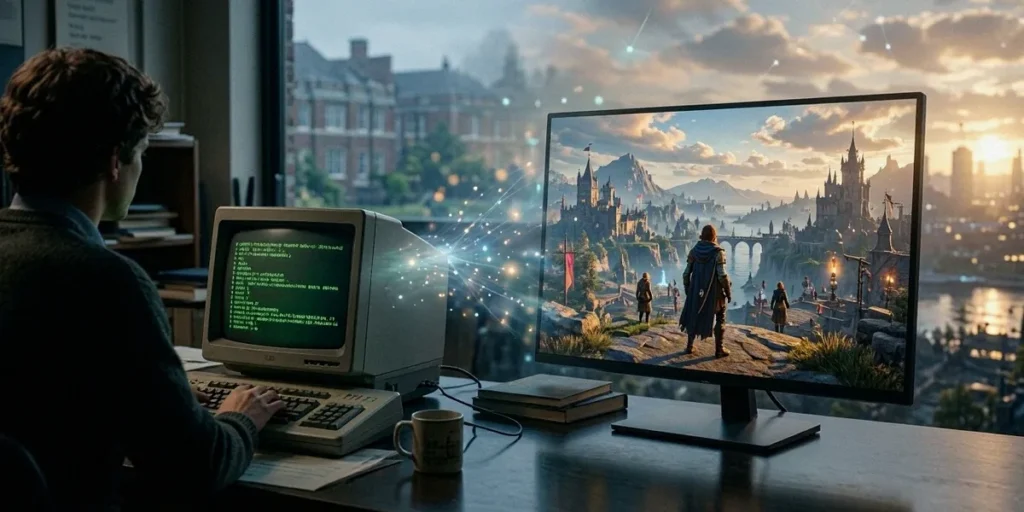
There are few feelings quite like it: the cursor blinking on a black screen, the modem screeching its familiar handshake, and then those words scrolling up — “You are standing in a clearing.” For a generation of UK players, connecting via Telnet to a text-based world was the first taste of online gaming, and it happened long before anyone talked about servers, lobbies or loot boxes. MUDs — multi-user dungeons — were the original shared online worlds, and their story starts right here in Britain. We want to take you back through that history, from a university computer lab in Essex to the browser games millions still play today, and explain why MUD games remain such an important part of our retro gaming heritage.
The Birth of MUD at Essex University
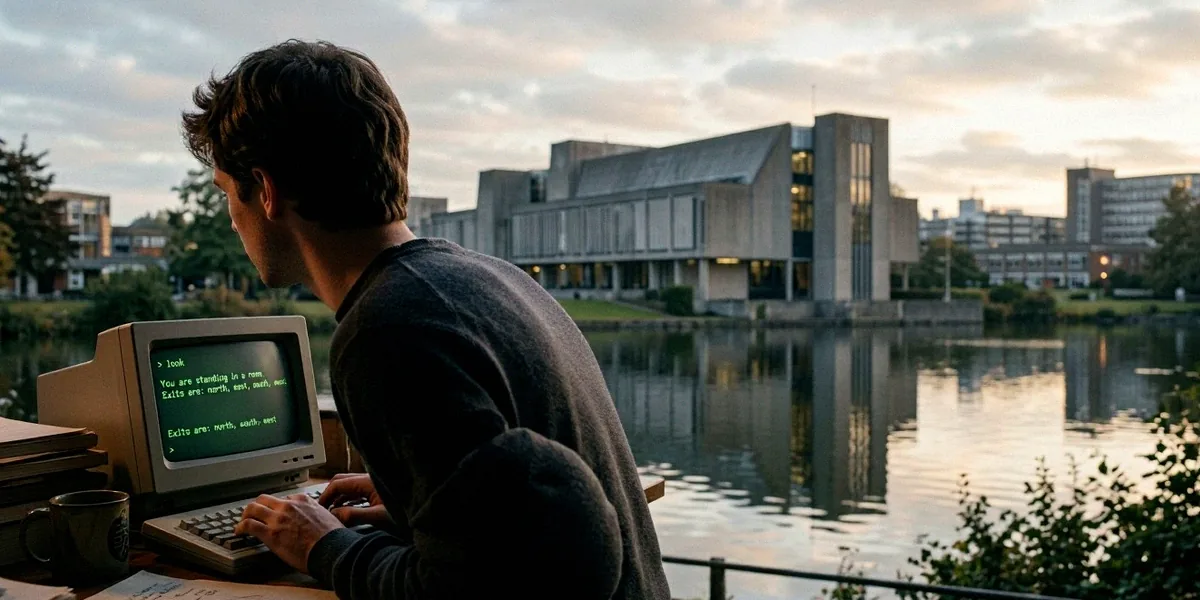
Long before the commercial internet, university mainframes were humming with experiments that would shape how we play together online. The most important of these for gaming history took place at Essex University, where two students built something nobody had quite imagined before: a shared, persistent, text-based world.
Roy Trubshaw and Richard Bartle: The Pioneers
In 1978, Roy Trubshaw began writing a multi-user game on a DEC PDP-10 mainframe at Essex University. The following year, Richard Bartle joined the project and helped transform it into something genuinely playable. Together, Roy Trubshaw and Richard Bartle created the template that every online RPG would later follow: multiple players logging in at once, exploring a shared space, and interacting with each other as much as with the game itself. Their work was academic in setting but unmistakably playful in spirit — and it laid the foundation for an entire industry.
MUD1: The First Multi-User Dungeon
The game they built became known as MUD1, widely recognised as the first multi-user dungeon. Running on the university’s DEC PDP-10, MUD1 combined role-playing, puzzles, combat and social chat in a single text-based environment. It was a dungeon crawler, a chat room and a community all at once — a combination that had never existed before. Players typed commands, read descriptions and mapped the world in their heads, and that act of imagination became the defining feature of the genre.
From Essex to ARPANET: Going Global
MUD1 went live on ARPANET in 1980, which took this Essex-built experiment and put it in front of players far beyond the UK. Suddenly, someone in the United States could log in and explore the same world as a student in Colchester. That moment marks the point at which the multiplayer online game stopped being a local curiosity and became an international phenomenon — and it all began with a Telnet connection and a wall of text.
How MUDs Spread Across the UK and Beyond
MUD1 did not stay unique for long. Its influence rippled outward across British universities and then across the Atlantic, producing a wave of variants that each pushed the format in a new direction.
MUD2 and Commercial Success in the UK
Richard Bartle later developed MUD2, a more refined version of the original concept. Crucially, MUD2 became one of the first commercial online games, charging players for access at a time when most people had never paid for anything on a network. In the UK, it proved that text-based RPG worlds could sustain a paying audience — an idea that later underpinned the entire subscription MMO model.
AberMUD and the Welsh Connection
Across Britain, other students were building their own versions. At Aberystwyth University, a variant known as AberMUD was written, and it became one of the most widely distributed MUD codebases in the world. AberMUD’s influence was enormous: its code travelled between universities and hobbyist servers, spawning countless derivatives and helping standardise how these games were built. The Welsh connection is often overlooked, but without Aberystwyth University the global spread of MUDs would have looked very different.
TinyMUD and the Social Evolution
Meanwhile in the United States, TinyMUD shifted the emphasis away from combat and scoring toward building, roleplay and social interaction. Where earlier MUDs were about defeating monsters and gaining levels, TinyMUD-style games were about creating spaces and communities. This split — adventure-focused versus socially-focused — still defines online gaming today, from hardcore raid guilds to the social hubs of modern MMOs.
The Golden Age of Telnet Gaming and Text-Based RPGs
For UK players in the 1990s, MUDs were not a historical curiosity — they were simply what online gaming was. If you wanted to play with other people, you dialled up and started typing.
Dial-Up Days: BBS and MUDs in the UK
Many of us first encountered these worlds through bulletin board systems. UK players would dial into a local BBS, often paying by the minute, to read messages, download files and sometimes connect onward to a MUD. The squeal of a 14.4k modem and the terror of a parent picking up the phone mid-session are shared memories for a whole generation of British gamers. Telnet gaming was the bridge: a simple protocol that let you reach a world hosted hundreds of miles away, as long as you could keep the line open.
Discworld MUD: A British Institution
No discussion of UK MUD culture is complete without Discworld MUD. Based on Terry Pratchett’s beloved novels and launched in the early 1990s, it became a genuine British institution — a sprawling, witty, deeply detailed world run by volunteers and sustained by an extraordinarily loyal player base. For many UK players, Discworld MUD was their first proper online community, and it is still running today, which says everything about the dedication of the people who keep it alive.
Tools of the Trade: Telnet and MUD Clients
Serious players quickly moved beyond raw Telnet and adopted dedicated MUD clients. The most famous was TinyFugue, a Unix client that allowed scripting, triggers and aliases — effectively letting players automate repetitive tasks and manage complex combat. A typical 1990s MUD toolkit looked something like this:
- TinyFugue — the powerful, scriptable client of choice for experienced players
- Plain Telnet — the simplest way in, built into most university and home systems
- Zmud and similar clients — popular on home computers for their colourful interfaces
- Hand-drawn maps and notebooks — essential for navigating worlds with no automap
Learning to script in TinyFugue was many UK players’ first taste of programming, and plenty of careers in tech started with a trigger that auto-healed at low health.
From Text to Graphics: The MMO Revolution
As the 1990s drew to a close, the text-based world met the graphical one — and the results changed gaming forever.
Ultima Online and the Graphical Leap
Ultima Online arrived in 1997 and gave the MUD formula a visual body: an isometric world, clickable characters, and thousands of players sharing one persistent space. EverQuest followed in 1999 and pushed the formula further into 3D. Underneath the graphics, though, the systems were recognisably MUD-derived — skills, guilds, chat channels, player-run economies and all.
RuneScape: A UK MMO Phenomenon
Britain’s biggest contribution to this era came from Jagex, a Cambridge-based studio whose browser game RuneScape launched in 2001. RuneScape was playable on almost any school or home computer, needed no installation, and offered a vast world of skills, quests and socialising. It kept the text-based spirit alive in a different way: quest dialogue, chat-driven communities and systems that owed an obvious debt to MUD design. For a huge number of UK players, RuneScape by Jagex was their gateway into online worlds — and many of them had no idea they were playing a descendant of MUD1.
The Decline of Traditional MUDs
As graphical MMOs grew, traditional MUDs gradually lost the mainstream audience. Player expectations shifted toward visuals, voice chat and slick interfaces, and the dial-up connections that had made text worlds feel magical became a thing of the past. The player base did not vanish, though — it concentrated. Smaller, tighter communities kept their worlds running, often for decades, funded by donations and sheer affection.
The Legacy of MUDs in Modern Gaming
It would be easy to file MUDs away as a footnote. We think that misses the point entirely, because the genre never really died — it adapted, and its DNA is everywhere.
Interactive Fiction and Modern Text Adventures
Interactive fiction has enjoyed a genuine revival, with modern tools making it easier than ever to write and publish text adventures. Annual competitions, itch.io releases and thriving forums keep the form alive, and there is a healthy overlap between interactive fiction fans and those who still log into a MUD games server for an evening. The pleasure of reading a well-written room description has not aged a day.
UK Retro Gaming Events and Communities
In the UK, retro online games are celebrated at events, university societies and online communities where players swap stories about their first MUD, their favourite client scripts and the worlds they still miss. Directories such as MUD Connector remain valuable starting points for anyone wanting to find an active game, and there is a steady trickle of new players discovering text-based RPGs for the first time.
MUD Mechanics in Today’s MMOs
Look closely at any modern MMO and you will find MUD mechanics still doing the heavy lifting:
- Persistent shared worlds where player actions leave a mark
- Guilds, clans and chat channels that mirror early MUD social structures
- Skill and level progression systems refined across decades of text games
- Player-run economies and trading cultures that began in text
- Volunteer moderation and community governance pioneered by MUD administrators
Even the language we use — “mobs”, “zones”, “nerfs”, “alts” — comes straight out of the text-based era.
MUDs are not just nostalgia for us. They are the foundation stone of online gaming in Britain, built by students at Essex University and Aberystwyth University, sustained by communities around Discworld MUD and countless smaller worlds, and carried forward by studios like Jagex. Whether you are returning to Telnet gaming after twenty years or opening a MUD client for the very first time, you are joining a tradition that is over four decades old — and still very much alive.
FAQ
What exactly is a MUD?
A MUD, or multi-user dungeon, is a text-based online game where many players connect at once to explore a shared world, fight monsters, solve puzzles and chat. Everything is described in writing, and you play by typing commands. The first one, MUD1, was created at Essex University by Roy Trubshaw and Richard Bartle.
Can I still play MUDs today?
Absolutely. Hundreds of MUD games remain online, including long-running British worlds such as Discworld MUD. You can find active games through directories like MUD Connector, and most can be accessed with a simple Telnet connection or a modern MUD client.
What is the difference between a MUD and an MMO?
An MMO is essentially a MUD with graphics. Both use persistent shared worlds, character progression, guilds and chat. MUDs rely on text descriptions and typed commands, while MMOs use 2D or 3D visuals — but the underlying design principles came directly from the text-based games of the late 1970s and 1980s.
Do I need to be technical to start Telnet gaming?
Not at all. You can connect using Telnet, which is built into most operating systems, or download a free MUD client with a friendlier interface. Basic commands like looking, moving and talking are easy to pick up, and most communities are welcoming to newcomers.
Why do MUDs matter to UK gaming history?
Because the genre was born here. MUD1 was created at Essex University, AberMUD was written at Aberystwyth University, Discworld MUD became a British institution, and RuneScape by Jagex brought the spirit of text-based worlds to millions. The UK did not just adopt online gaming — we helped invent it.