
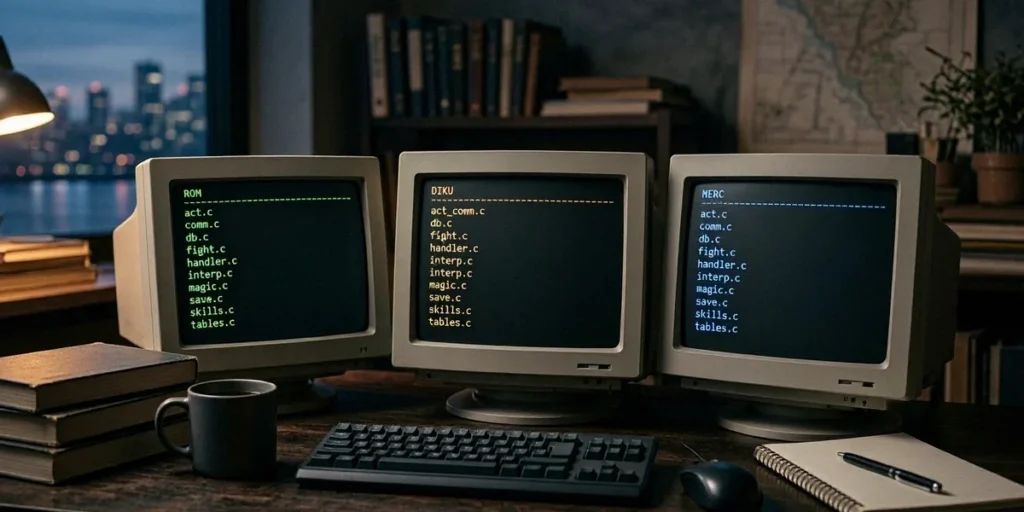
ROM, Diku and Merc: A Guide to Classic MUD Codebases
There’s a particular kind of nostalgia that only hits when the modem screeches, the terminal flickers to life, and a wall of text starts scrolling past faster than you can read it. For those of us who grew up logging into Telnet sessions late at night, MUD games were our first taste of shared online worlds — long before graphics cards and voice chat. Behind almost every one of those worlds sat a codebase: the engine quietly handling rooms, combat, mobiles and chatter. In this guide, we’re looking at the three that shaped the landscape more than any others — DikuMUD, ROM and Merc.
What Are MUD Codebases and Why They Matter

A codebase is the underlying engine of a MUD game. It defines how rooms connect, how combat resolves, how mobiles wander, how spells behave and how players talk to one another. Without a codebase, you have nothing but an idea and a lot of enthusiasm. With one, a single administrator can launch a fully playable text-based RPG in a matter of weeks. DikuMUD, ROM and Merc are among the most influential engines ever written, and they still power retro online games running today.
The Role of a Codebase in Text-Based RPGs
Think of the codebase as the skeleton and the area files as the flesh. The codebase handles the mechanics — hit rolls, mana regeneration, mobiles, object handling, communication channels — while builders write the zones, quests and lore that sit on top. This separation is what made MUDs so scalable: one team could maintain the engine while dozens of volunteers wrote content.
How Codebases Shaped UK MUD Culture
Many UK universities hosted early MUDs on their servers, and that access fostered a genuinely local community. Students at institutions across the country dialled in from computer labs, shared accounts, and built zones in between lectures. The result was a distinctly British flavour of MUDding — irreverent, chatty, and deeply social.
DikuMUD: The Granddaddy of Multi-User Dungeons
DikuMUD was created at the University of Copenhagen in 1990 by a group of students who wanted something more structured than the earlier TinyMUD family. Written in C and designed for speed on the hardware of the day, it became the template that almost every combat-focused MUD would follow for the next decade.
Origins and Design Philosophy
The Diku team’s goal was a playable, hack-and-slash experience with clear rules and a stable engine. They favoured structured gameplay over pure social experimentation, and that decision proved enormously influential. Many UK MUDs, particularly those hosted on early university servers, ran Diku derivatives rather than the original code.
Key Features: Zones, Mobiles, and Objects
Diku introduced or popularised several conventions that became standard across text-based RPGs:
- Zones — self-contained areas with their own level ranges and reset timers
- Mobiles — non-player characters with behaviours, equipment and dialogue
- Objects — items with wear locations, weights and special flags
- Group-based combat — tanks, healers and damage dealers working together
Legacy and Influence on Later Codebases
Nearly every combat MUD you’ve played traces a lineage back to Diku. Its licence terms were restrictive, which ironically spurred the creation of derivative codebases that reworked or replaced the original code — ROM and Merc among them.
ROM: The Diku Offshoot That Won Hearts
ROM was released in 1993 as a Diku derivative, and it quickly became the codebase of choice for administrators who wanted a cleaner, more flexible engine. It shipped with a solid set of area files and a combat system that felt more balanced than its predecessor.
How ROM Improved on DikuMUD
ROM refined the skill and spell system, introduced better mobile AI, and cleaned up a lot of the code that had grown messy in Diku. It also made area building more accessible, which mattered enormously when your building team was a rotating cast of volunteers.
The ROM Community and Area Files
The ROM community became one of the most active in MUDding. Shared area files circulated on FTP sites and mailing lists, and UK players contributed heavily to the pool. Classic MUD games running ROM 2.4 were a staple of the British scene through the mid-to-late 1990s.
Why ROM Remains a Favourite for Telnet Gaming
ROM is still one of the easiest codebases to get running. It compiles cleanly on modern systems with modest tweaking, and there’s a wealth of documentation. For anyone curious about Telnet gaming today, a ROM-based MUD is often the friendliest place to start.
Merc: The Codebase That Merged and Evolved
Merc took a different path. Rather than starting fresh, it merged Diku and ROM elements into a single, more stable engine. The result was a codebase that appealed to administrators who wanted ROM’s features without its quirks, and Diku’s reliability without its baggage.
The Merger of Diku and ROM
Merc’s creators pulled the best bits from both lineages, prioritising stability and ease of use. That pragmatic approach won over a lot of UK-based MUD administrators who were tired of patching bugs in their spare time.
Merc’s Technical Innovations
Merc introduced improvements to the object and mobile handling, tightened up the fight code, and made the whole system easier to extend. It wasn’t flashy, but it was dependable — and dependability matters when your player base logs in every evening.
From Merc to SMAUG and Beyond
Merc went on to spawn SMAUG, one of the most popular derivatives in MUD history. SMAUG added features like clans, quests and improved combat, and it’s still running on MUDs today. The Merc lineage is a perfect example of how open sharing kept this hobby alive.
Comparing ROM, Diku and Merc for Modern Players
If you’re thinking about dipping back into MUD games, or trying one for the first time, here’s how the three codebases stack up in practice. It’s worth noting that Discworld MUD, a popular UK-based MUD, is not directly based on these codebases but exemplifies the UK MUD scene — proof that the local culture outgrew any single engine.
Combat and Magic Systems
Diku offers the classic group-combat experience. ROM refines it with better balance and more interesting spells. Merc sits somewhere in between, with a reputation for stability over spectacle.
Building and Customisation
ROM is generally the easiest to build for, with extensive documentation and a large pool of shared areas. Merc is friendly to coders who want to extend the engine. Diku is the most restrictive, which is why so few original Diku MUDs remain in active development.
Finding Active UK MUDs Today
Plenty of retro online games still use these engines. A few places to look:
- MUD listing sites such as The Mud Connector, filtered by codebase
- Discord communities dedicated to ROM, Merc and SMAUG development
- University computing societies, some of which still host MUDs
- Open source repositories where classic codebases are archived and maintained
Why These Codebases Still Matter in 2025
Modern games have ray tracing and orchestral scores, but they rarely match the immediacy of a well-written MUD. The codebases we’ve covered here offer something graphics can’t: pure interactive fiction, driven entirely by imagination and text.
Preservation and Open Source
Thanks to preservation efforts and open source releases, ROM, Merc and various Diku derivatives remain available. UK players can still Telnet into MUDs running these engines, often within minutes of deciding to give it a go.
The Enduring Appeal of Text-Based RPGs
Text-based RPGs endure because they’re social, accessible and endlessly expandable. They run on anything with a network connection. They reward reading and writing. And they’re built by communities rather than corporations, which gives them a warmth that’s hard to replicate.
FAQ
What is a MUD codebase?
A codebase is the engine that powers a MUD game. It handles rooms, combat, mobiles, objects and communication, while area files provide the actual content players explore.
Which codebase should a beginner try first?
We usually recommend ROM. It’s well documented, easy to compile, and there are plenty of active MUDs running it that welcome new players.
Are DikuMUD, ROM and Merc still in use?
Yes. Many retro online games still run these engines or their derivatives, and SMAUG — descended from Merc — remains particularly popular.
Is Discworld MUD based on Diku, ROM or Merc?
No. Discworld MUD is not directly based on these codebases, but it’s a great example of the UK MUD scene and well worth exploring.
Do I need special software to play?
No. A Telnet client is enough, though many players prefer a dedicated MUD client with triggers and aliases for a smoother experience.
Whether you cut your teeth on a university server in the 1990s or you’re simply curious about Telnet gaming, DikuMUD, ROM and Merc are the foundation of a living history. They shaped how we think about online worlds, and they’re still running — waiting for your next login.